Hemp Project News
News and Updates on Industrial Hemp
New Mexico Hemp Bill Passed!
Mar 08, 2011 -
NM State Representative 7th term: Vice Chair; Ray Begaye, (D-NM 4th District ), is proud to announce that the New Mexico State - House Agriculture and Water Resources Committee has passed Bill HB 565, which is an Historic Bill, Relating to Agriculture: Providing for licensing the growing, selling and processing of“Industrial Hemp:” Rules to encourage growth, and sales of Industrial SANTHICA - which is THC-FREE.
This Bill HB:565 passed the agriculture committee 8-l this past Monday. The bill will go to the Judiciary Committee and then onto the Floor of NM legislature. The Bill will stimulate the NM economy with producers. Santhica is a good candidate for the production of textiles, biodiesel, plastics and vinyl and health foods.
Some interesting facts about
“INDUSTRIAL HEMP” (SANTHICA)
- Can be used for energy Production in thermal power plants
- A strong candidate for remiation in areas contaminated with hydrocarbons.
- Can produce biofuels/twenty gallons per acre
- French breeders have produced a hemp variety called SANTHICA, which is THC free.
- Nutrient-rich Hemp milk is good for lactose intolerant consumers.
- Uses significant amounts of carbon dioxide during photosynthesis and has tremendous potential for combating climate change.
- A replacement for petroleum products.
- President Clinton signer a National Defense Industrial Preparedness Executive Order No. 12919 – which listed HEMP among the essential agricultural products that should be stocked for national security purposes.
For a more in-depth look at this legeslation and the effects on agriculture in NM, go to RealNEO.us
Hempsters: Plant the Seed
Dec 22, 2010 -
Please Visit the Hempsters Homepage for information about the movie Hempsters: Plant the Seed
Hemp Hemp Hooray! Hemp Fashion
Nov 27, 2010 -
Hemp hemp hooray! from Rachael Joy on Vimeo.
Visit Hemp Hemp Hooray on EcoPop TV for more information!
Hemp as Renewable Energy
Nov 26, 2010 -
Important innovations in the production and use of biofuels directly relate to hemp agriculture. With few exceptions, industrial hemp is the most environmentally friendly and high-yield source of biofuel. The following studies and innovations are perfect examples.
Hemp produces viable biodiesel, study finds
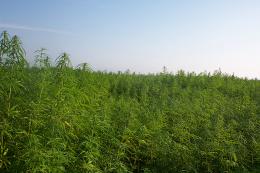
Of all the various uses for Cannabis plants, add another, “green” one to the mix.
Researchers at UConn have found that the fiber crop Cannabis sativa, known as industrial hemp, has properties that make it viable and even attractive as a raw material, or feedstock, for producing biodiesel – sustainable diesel fuel made from renewable plant sources.
The plant’s ability to grow in infertile soils also reduces the need to grow it on primary croplands, which can then be reserved for growing food, says Richard Parnas, a professor of chemical, materials, and biomolecular engineering who led the study.
“For sustainable fuels, often it comes down to a question of food
versus fuel,” says Parnas, noting that major current biodiesel plants
include food crops such as soybeans, olives, peanuts, and rapeseed.
“It’s equally important to make fuel from plants that are not food, but
also won’t need the high-quality land.”
Industrial hemp is grown across the world, in many parts of Europe
and Asia. Fiber from the plant’s stalk is strong, and until the
development of synthetic fibers in the 1950s, it was a premier product
used worldwide in making rope and clothing.
Today, there are still parts of the world that rely on Cannabis stalks as a primary fiber, mainly because of its ability to grow “like a weed,” without requiring lots of water, fertilizers, or high-grade inputs to flourish. But the seeds, which house the plant’s natural oils, are often discarded. Parnas points out that this apparent waste product could be put to good use by turning it into fuel.
“If someone is already growing hemp,” he says, “they might be able to produce enough fuel to power their whole farm with the oil from the seeds they produce.” The fact that a hemp industry already exists, he continues, means that a hemp biodiesel industry would need little additional investment.
With his graduate student Si-Yu Li and colleagues James Stuart of the Department of Chemistry and Yi Li of the Department of Plant Sciences, Parnas used virgin hemp seed oil to create biodiesel using a standardized process called transesterification. The group then tested the fuel for a suite of characteristics in the Biofuels Testing Laboratory at UConn’s Center for Environmental Science and Engineering.
The hemp biodiesel showed a high efficiency of conversion – 97 percent of the hemp oil was converted to biodiesel – and it passed all the laboratory’s tests, even showing properties that suggest it could be used at lower temperatures than any biodiesel currently on the market.
Read the rest at Physorg.com
A high-yield biomass alternative to petroleum for industrial chemicals
A team of University of Massachusetts Amherst chemical engineers report in today's issue of Science that they have developed a way to produce high-volume chemical feedstocks including benzene, toluene, xylenes and olefins from pyrolytic bio-oils, the cheapest liquid fuels available today derived from biomass. The new process could reduce or eliminate industry's reliance on fossil fuels to make industrial chemicals worth an estimated $400 billion annually.
Read the rest at Phsyorg.com
Hemcrete: Hemp Walls 7 Times Tougher Than Concrete
Nov 25, 2010 -
From Web Ecoist
carbon neutral – it’s carbon negative. Long-time greenies won’t be surprised to learn that the miracle material is actually hemp.
Tradical Hemcrete isn’t a high-tech solution to climate change. It’s simple, and it’s effective: it’s a light concrete made of hemp, water, and a lime binder. When the hemp grows, it sequesters carbon inside each plant, which is then effectively trapped there for good. At the same time, the plants release clean oxygen into the air. Even when you take the carbon footprint of the lime binder into consideration, Hemcrete overall removes more carbon from the environment than it contributes.
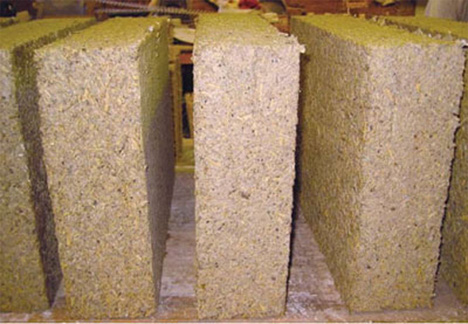
Unlike some other eco-friendly building materials, Hemcrete isn’t at all inferior to standard materials. It’s strong and durable, and it’s just as easy to use as standard materials. What’s even better is its versatility: it can be used for wall insulation, flooring and roofing, and it’s fire-proof, water-proof, and rot-proof as long as it’s above ground.
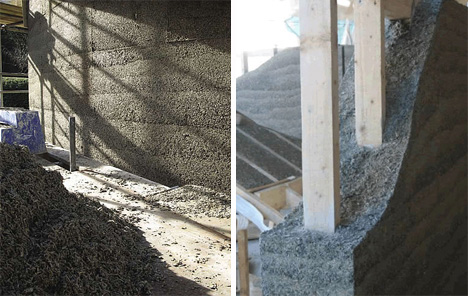
Hemcrete is so environmentally friendly that the manufacturers claim it can be broken down and spread on fields as a fertilizer after it’s lived out its useful life. It’s ultimately very renewable, since hemp plants are mature after 14 weeks of growth.
Hemp has been used for a wide variety of applications for thousands of years. Its modern resurgence among eco-minded consumers has been somewhat hindered by laws governing its growth. Certain types of hemp can’t be grown in certain parts of the world, and it just so happens that the type of hemp used to make Hemcrete is illegal in the US. That’s made it difficult (and expensive) for people in the US who want to build with it, but it is now available in the US – if you’re willing to pay a handsome price for it.
From Web Ecoist